


In 1992, AM and I visited Germany for the Messe Frankfurter international trade fair, for the installation of the 100% Make Up vase collection on the Alessi stand. Before the official presentation I went off to browse the various pavilions of the large fair where my gaze stopped to admire an African Ndebele ceremonial doll that had caught my attention.
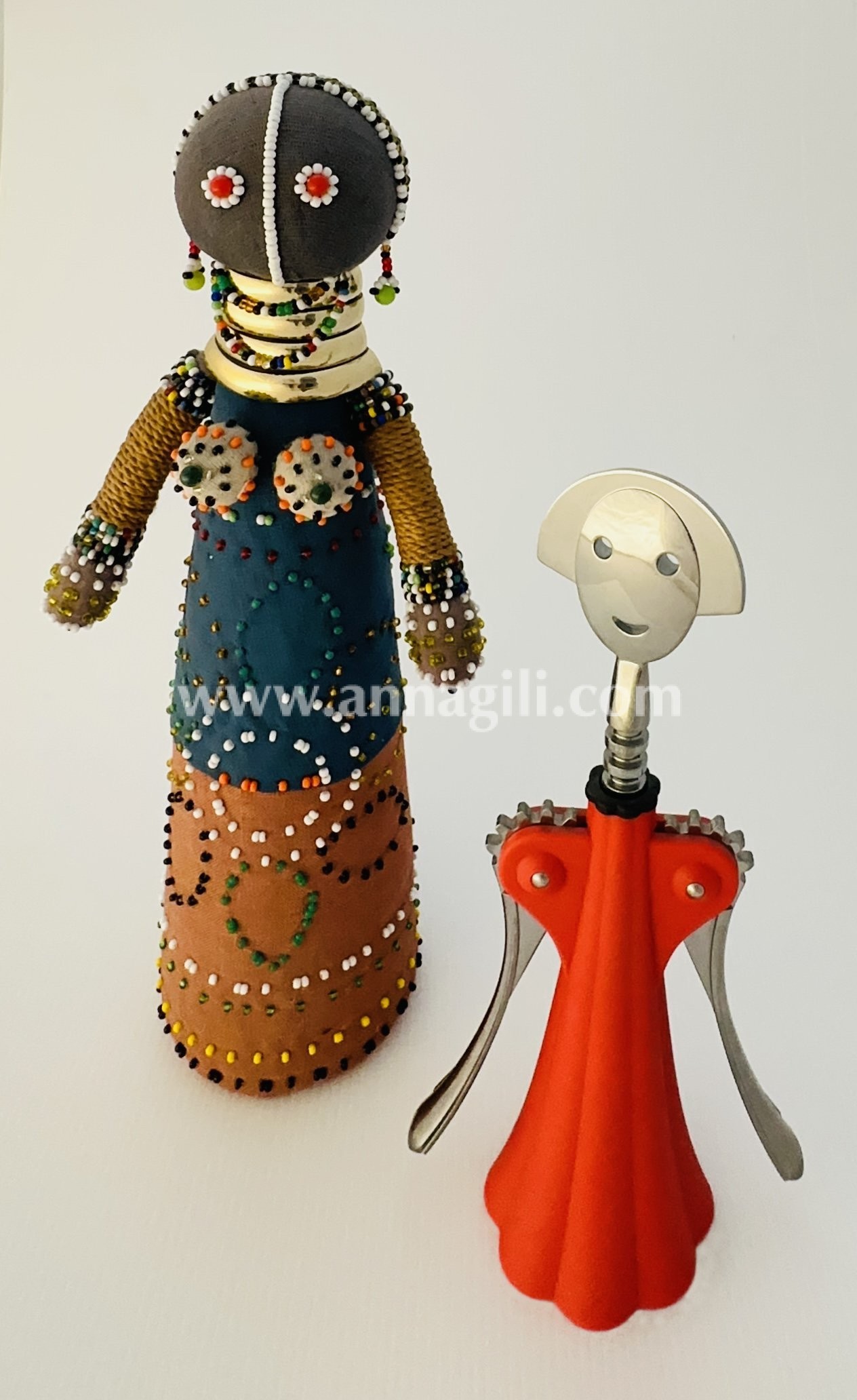
Today, in the ever more accessible global markets it is more easy to find artefacts from some of the most remote places in the world, but in 1992 this type of object could only be seen in a few international fairs, such as the one I was at in the Messe Frankfurt trade fair or in specialist collectors’ galleries. I was totally struck by this fetish doll, it was mesmerising and, in retrospect, I now understand the reasons for this. It was an object that somehow represented my figure, for the compactness of its body and a long neck adorned with golden rings. It summarised the genesis of the iconic object, which would be designed a few years later, the Anna G. Corkscrew, a design portrait dedicated to me, produced by the Alessi company, which bears the signature of Alessandro Mendini.
The essentiality of the African doll was based on simple geometries: a sphere covered in black jersey a vertical line of white beads dividing the face, with two white circles and two larger red beads in the centre of the circles representing the eyes for the face. The body is a cone shape and two long thin cylinders for the arms wrapped in grey rope, with the shoulders and little round oval ends representing the hands all intricately beaded. The lower part of the body covered with a brown tan fabric like the colour of the earth and, as such, had radial patterns with glass beads that resembled the Earth's parallels. In the narrowest part of the cone at the top, the fabric was blue like the sky, ending with two grey spheres to indicate the breasts, decorated with beads also arranged in a circular direction. A long neck rose from the top of the cone completely covered by a series of gold-coloured rings.
In my opinion, it was an extraordinary object and it had won me over. I asked the girl at the stand how much the doll cost and if I could buy it, she explained that it was not possible to sell to private individuals at the fair. She had understood, however, that I really liked the object, I had told her that I would be attending the fair every day for the entire duration and so, she let me know that before dismantling the stand on the last day she could possibly give me the artefact. I eagerly awaited for the closing day, in the hope of receiving the doll from the woman, I went and found her with the object wrapped in a bag which she gave to me. I placed my treasured Borsalino hat on her head, she liked it and so we made an exchange and were both very satisfied, without having broken the local rules that prohibited the unofficial sale of products on the stands.
On our return from Frankfurt, Alessandro noticed the object in my studio, where it remains today, he liked it and said how much it resembled me. Then after a while he came back to see it again and told me that he was working on a corkscrew project for Alessi and found the ceremonial doll that resembled my appearance interesting. We spoke several times about the corkscrew, about my figure, about the act of raising my arms to extract the cork, a gesture that must have seemed like a ritual and joyful act. A.M. and I had been together, since 1984, and were very much in love and this object seemed to synthesise all our complicity and happiness of being together, both in it’s function and in its iconic aspect. As we were both designers we had great pleasure sketching, doodling, scribbling and wordsmithing potential ideas together, like solving jigsaw or crossword puzzles. And so it was also in this case, studying together innovative solutions. A.M. then brought the ideas that we had developed to Atelier Mendini, to prepare working drawings. Finally, once the project was underway we talked about the name to give to the corkscrew. A.M. and I both understood from the moment Alberto Alessi proposed giving it my name Anna Gili, that our complicity no longer belonged to us, we had to share this object(s) with Alberto and with the public world linked to Alessi. I suggested it could only have the name Anna accompanied by the first letter of my surname, the letter G with a dot G., it was a veil that would give a certain mystery and intrigue to the object in my opinion. Read the article "Anna Gili talks about the Anna G. Corkscrew"
There are multiple versions of the Anna G. corkscrew, always ironic and funny, in the style and character of A.M., always with my approval and the participation in all the choices of Alberto Alessi, guru and intellectual of the Alessi company. In 2003, the Alessandro M. corkscrew was born and limited edition series were produced with the couple Anna G. and Alessandro M. among the most admired versions I remember the parodic ones of Superwoman and Superman, others with the “Mendiniano” decoration, with “Proust” decoration, and in the most varied colors, none of which was devoid of irony.
It is always amusing to see myself as the tall Anna G. and Alessandro M. as the small cute man, as a couple we were quite eye catching for this reason and A.M. captured and celebrated this fact in what was to become a Domestic Tool and a cult object as this is became a best seller for Alessi. Alessi’s Anna G. and Alessandro M. design versions takes up 10 pages in the large coffee table book, Codice Mendini written by Fulvio Irace with Mendini’s guidance and direction:- From the Anna G. 5 meter giant sized sculpture 1996, "Anna G.’s Music Band" conducting a sea of Alessandro M.’s corkscrews in orange, Anna G. corkscrew in polished steel, “Anna Pepper” 2000, pepper grinder, “Anna Fire” 1998 as a stove top lighter, a box right down to several Alessandro M. and Anna G. 2004 “Anna Stop” bottle stopper designs and “Anna Sparkling” 1998
Codice Mendini, Le Regole per Progettare di Fulvio Irace, ©2016 Mondadori Electa S.p.A., Milano
© Anna Gili 2024
© Copyright 2026 – All rights reserved – ANNA GILI – Designer and artist – Milano – P.I. 08026750151 – Credits by Futuraweb srl